Gunite vs. Shotcrete vs. Concrete for Inground Pools
Quotes for an inground pool almost always name a construction method, and the ones you will see most often are gunite, shotcrete, poured concrete, and fiberglass. Understanding those three makes the price differences between those quotes much easier to read.
This article covers what each method changes about the finished pool, which methods tend to suit which kinds of yards, and the questions worth asking a builder before you choose. It is worth spending a little time on this one early, since the shell is the part of the pool you keep for the long run.
What Is Gunite vs. Shotcrete vs. Concrete? The Short Answer
All three methods build a structural shell out of concrete and steel, and the difference between them is how the concrete gets where it needs to go. That one variable is what determines which shapes are available to you, what your yard needs to accommodate, and how long the shell will last.

What Is the Difference Between Gunite and Shotcrete?
This is the most common question in the category, and the useful answer is that the two are closer than the different names suggest.
Both methods spray concrete at high pressure onto a steel rebar framework, both bond directly to that steel, and both can produce any shape you are able to draw. The difference is when water joins the mix: with gunite, dry material travels through the hose and water joins at the nozzle, while shotcrete arrives already wet and the crew sprays it as a finished mix.
That distinction matters to the crew doing the work. Gunite gives an experienced nozzleman real-time control over the mix, which is why many custom builders prefer it, and shotcrete offers more consistency in the mix itself. Either one, applied well, gives you a sound shell.
For you as the homeowner, this means you can set the gunite-versus-shotcrete question aside fairly quickly and spend your attention on the builder instead. How skillfully a crew applies the material has far more effect on your finished pool than which of the two they use.
For a broader look at how these approaches compare, our pool construction types page covers the methods we build with and where each one fits. Our older gunite construction overview walks through our approach from design and excavation through gunite application, finishing, and long-term care at a high level.
Gunite vs. Concrete Pool: How Poured Concrete Differs
Poured concrete uses the traditional approach, where a crew builds forms and pours concrete into them rather than spraying it onto steel.
For a rectangular pool on a flat lot with good access, it is a sound method. What it does not do as readily is handle curves, varied depths, an integrated spa, a tanning ledge, or a vanishing edge on a grade, since each of those needs formwork that grows complicated and expensive to build.
The other point of comparison is seams. A sprayed shell goes on in one continuous application, while poured work leaves cold joints where one pour meets the next. We spray rather than pour so the shell stays a single piece and stays off your maintenance list.
Where Fiberglass Fits
Fiberglass is not named in the title, though it is likely on your list, so it is worth covering properly.
A fiberglass pool is a shell built in a factory and lowered into an excavation. Installation is much faster, often weeks rather than months, the upfront cost is lower, the surface is smooth, and routine maintenance is lighter.
What you trade for that is design range. The mold sets the shape, size, and depth, transport caps the maximum dimensions because the shell has to travel by truck and reach your backyard in one piece, and your feature options are the ones the factory offers.
That makes fiberglass a good fit when speed and entry cost are what matter most to you. When you want the pool shaped around your particular yard, a sprayed shell is the route that gets you there.
Four Questions That Point You to the Right Method
You can reach a confident answer without comparing material specs. These four questions do most of the work.
How Custom Does It Need to Be?
A sprayed shell can be built to whatever you design, including free-form curves that follow your property line, a tanning ledge at the depth you want and sized for the loungers you already own, a raised spa built into the pool wall rather than set beside it, and a shallow end for a five-year-old alongside a deep end for a fifteen-year-old.
A mold gives you a well-made version of a shape that was designed before your yard was part of the conversation. We build custom shells so the finished pool reflects your property and your family rather than the closest available template.
How Long Do You Need It to Last?
A properly engineered and maintained gunite or shotcrete shell is a permanent structure, which is why “how long do gunite pools last” is among the most searched questions in this category. Plan in decades, with the interior finish refreshed periodically rather than the shell replaced. Our breakdown of pool finish types covers how texture, color, and maintenance needs differ across those finishes and how often each one typically needs attention.
Fiberglass is durable, and its gelcoat surface has a service life that may need attention over time. Poured concrete performs well when the reinforcement was executed properly, which makes the builder’s track record especially worth checking.
The most useful way to compare is across twenty years rather than at signing, since the shell is the component you keep as-is while everything around it gets refreshed.
What Does Your Yard Allow?
Grade, soil, and access shape this decision more than most homeowners expect going in, and they are worth raising early.
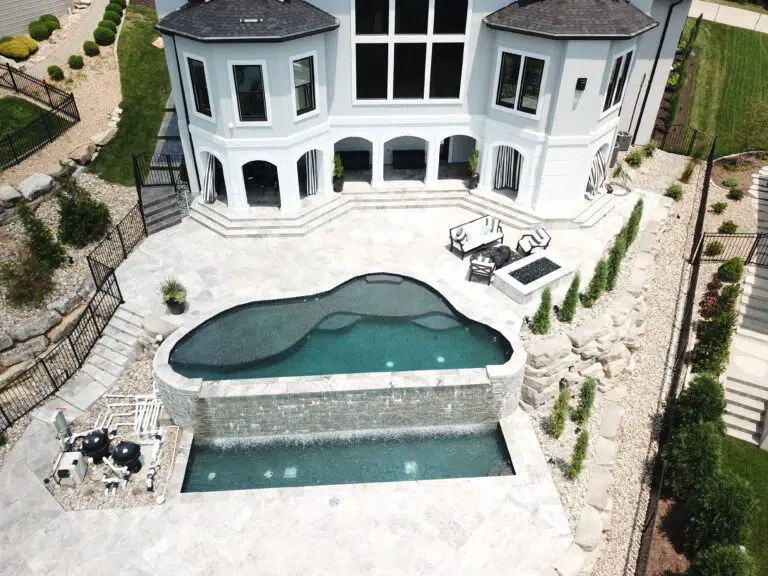
Sloped lots are where sprayed construction has the clearest advantage. We can engineer a shell to work with a grade, incorporating retaining structures and multi-level decking, and those builds often end up more interesting than the same budget spent on a flat lot. A prefabricated shell needs a level, prepared excavation, so a slope means additional site work before the pool arrives. If your yard falls away behind the house, our guide to building a pool on a sloped yard shows how we use that grade as a design feature.
Access is worth checking too, since a factory shell has to physically reach your backyard, and on tight or wooded lots that can settle the question on its own.
What Is the Resale Reality?
A custom pool built into a well-designed backyard reads to a future buyer as part of the house, while a prefabricated shell set into a lawn reads more like an addition to it.
If property value is part of your thinking, how well the pool integrates matters as much as the pool itself. Pool, decking, hardscape, and landscape designed together is what shows up in an appraisal and in an offer, and it is why we design the whole space at once rather than leaving the surroundings for a later project at a higher cost.
Gunite vs. Shotcrete vs. Concrete for Inground Pools: Which One Fits Your Project?
The short version, organized by what you care about most:
| If your priority is… | The method that fits |
|---|---|
| A fully custom shape, depth, or integrated feature | Gunite or shotcrete |
| The longest structural lifespan | Gunite or shotcrete |
| Building on a slope or an irregular lot | Gunite or shotcrete |
| The lowest upfront cost | Fiberglass |
| The fastest install | Fiberglass |
| A simple rectangle on a flat, open lot | Poured concrete or fiberglass |
A sprayed shell, gunite or shotcrete, is probably right if:
- You want a pool designed around your yard rather than selected from options
- You are building on a slope, an irregular lot, or a tight footprint
- You want an integrated spa, tanning ledge, vanishing edge, or water feature
- You plan to stay in the home long term
- You are treating this as a property investment as well as a summer purchase
Fiberglass is probably right if:
- Getting in the water quickly is your top priority
- Your budget ceiling is firm and lower
- A standard shape suits your yard and your family well
- Delivery access to your backyard is straightforward
Poured concrete is worth discussing if:
- Your design is simple and rectangular
- Your lot is flat with easy access
- Your builder has strong, verifiable experience with the method

Questions to Ask Any Builder About Construction Method
Take these to every quote you are holding, since the answers tell you more than the pricing does.
Which method do you use, and do you spray in-house or subcontract it? In-house crews mean the company that designed your pool is the company building the shell, which keeps accountability in one place.
What shell thickness and rebar spacing do you build to? A builder who knows their own specs will answer without checking, and that tells you how closely they supervise the work.
Is my plan engineer-stamped for my specific soil and grade? A plan stamped for your property accounts for your soil conditions, which is what a standard drawing adapted to fit cannot do.
What does your structural warranty cover, and for how long? Ask about the exclusions alongside the coverage, because that is where you learn what the warranty actually does for you.
How many pools have you built on a lot like mine? Sloped, wooded, and narrow-access lots each bring their own considerations, so relevant experience is more useful than general experience.
Which interior finishes do you offer, and are you certified to install them? Certification is something you can confirm with the manufacturer.
Can I see a pool you built five or more years ago? This is the most informative question on the list, since a new pool looks good regardless of who built it, and five years shows you how the work holds up.
Good signs to listen for: a builder who names their own specs readily, offers older work without being pressed, provides warranty terms in writing, and can explain why their method suits your particular yard.
How Elevate Pools Builds
We build custom gunite pools with in-house crews rather than subcontracting the shell, and every project begins with an engineer-stamped plan specific to your soil conditions and your grade.
Elevate Pools is one of only two PebbleTec Elite Builders in the St. Louis metropolitan area, which means the manufacturer certifies our interior finish work.
We are also part of Elevate Outdoor, so the same team handles decking, hardscape, outdoor kitchens, fire features, and landscaping. One company designs your backyard as a single space, which keeps the whole project on one schedule and one point of contact. You can see how that comes together across the builds in our project gallery.
Why This Choice Comes First
Tile can be replaced, furniture gets swapped out, landscaping matures and evolves, and interior finishes are refreshed on a schedule. The shell is the piece that stays, which is why it earns a little more thought than the decisions that follow it.
Getting the construction method right for your yard, your design, and how long you plan to enjoy it sets up everything built on top of it.
When you want to walk your specific yard and talk through which approach makes sense for it, start your quote and we will set up your design visit.